
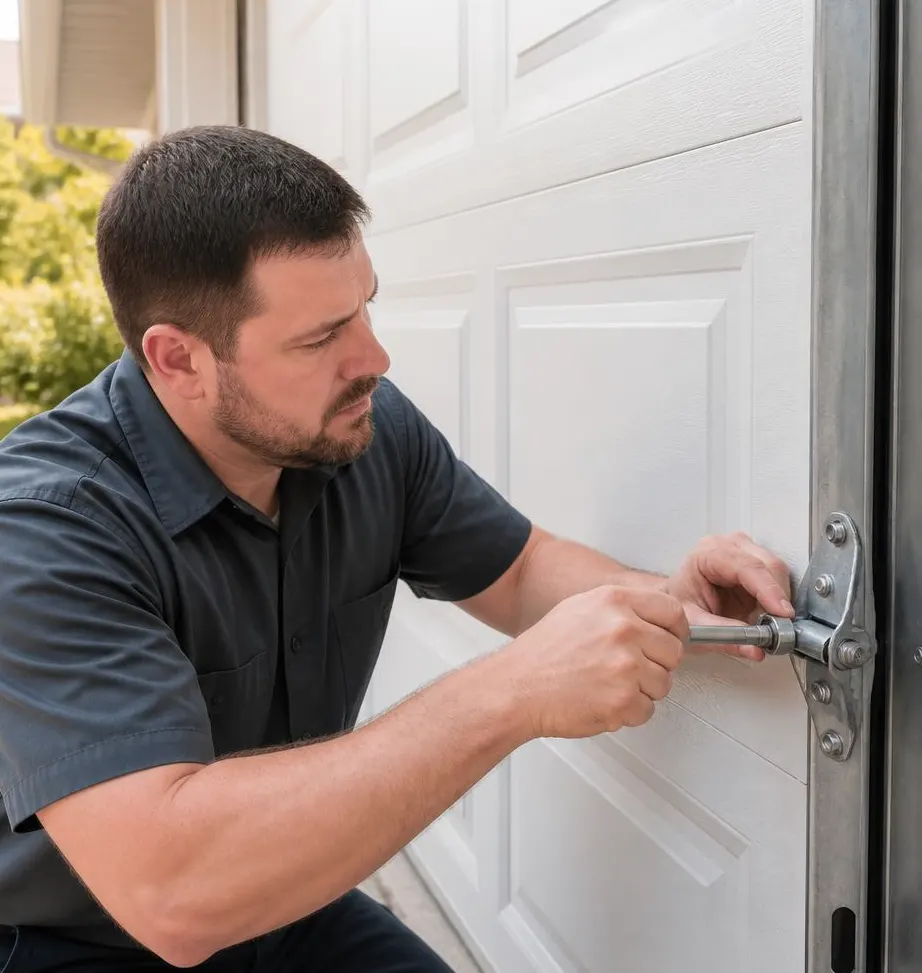
What a Technician Sees on This Call
The call usually starts the same way: one spouse wants the whole door replaced, the other thinks that's a waste of money because "it still opens and closes fine." When a technician shows up to look at a door that's been in service since the 90s, they're not checking whether it works. They're checking whether it's safe, and those are two different questions. Most of these doors have the original torsion springs, the original remote, and an opener that reverses when it feels like it rather than when it's supposed to. That's the real argument underneath the argument.
The One Retrofit That Isn't Optional: Auto-Reverse Sensors
Federal safety standards changed in 1993 to require garage door openers to have auto-reverse protection, including the small photo-eye sensors mounted near the bottom of the tracks. If your door predates that update, or if someone swapped in an older opener later, there's a real chance those sensors were never installed. Without them, a door closing on a kid, a pet, or a bike doesn't stop — it keeps going. This is the one item in this whole list that should not be left alone, no matter how well the rest of the door is holding up.
Spring Safety Cables
Torsion springs under tension store a lot of energy, and when an old spring finally snaps, it can whip violently. Newer installations run a safety cable through the spring so that if it breaks, the cable keeps it contained instead of letting it fly. Older setups often don't have this. It's a low-cost add-on compared to the risk it covers, and it's worth checking for on any door that's never had its springs replaced.
Opener Security: Rolling Codes
Older remotes broadcast a fixed code every time you press the button. That code can be captured and replayed by cheap, widely available devices — it's not a theoretical risk, it's an old and well-documented one. Modern openers use rolling codes that change with every use, closing that gap. If your remote still has a simple dial of switches on the back to set the code, that's the old style.
Wind-Load Bracing for Storm Season
Doors built before current wind-load standards weren't engineered with the bracing that keeps a door from buckling or blowing in during high wind. In this part of Florida, hurricane season isn't a once-in-a-while concern — it's an annual planning item, and a door that fails during a storm can take out more than itself. If your door is original to a house built in the 90s or earlier, it's worth having someone confirm whether it has adequate reinforcement, especially if you're closer to the coast where salt air also speeds up corrosion on hardware and fasteners.
What You Can Leave Alone
- Solid panels with no rust or warping. Age alone isn't a reason to replace a door that's structurally sound and operating smoothly.
- Heavy-gauge tracks that are still straight and quiet. Old doesn't mean worn out if there's no grinding, binding, or visible bending.
- Original springs that are properly balanced and maintained. Springs have a finite cycle life, but if they're not rusted, frayed, or sagging, there's no need to replace them just because of their age — just keep an eye on them.
Settling the Argument: A Quick Checklist
- Place a 2x4 flat on the ground where the door closes. If the door doesn't reverse on contact, the auto-reverse system needs attention now.
- Look at the springs for a thin cable running through the coil. No cable means no containment if it breaks.
- Check the remote. If it has physical dip switches instead of a sync button, it's using a fixed code.
- Listen for grinding or watch for sagging in the middle of the door when it's halfway open — that points to spring or cable wear, not opener age.
When to Call Caryville Overhead Door Co
If the 2x4 test fails, if you can't find a safety cable on the springs, or if you just want someone to confirm what's actually safe versus just old, that's exactly the call to make. We handle Garage Door Opener Installation for homes ready to move to a rolling-code, auto-reverse system, and Garage Door Cable Repair for springs and cables that need safety upgrades without replacing the whole door. We'll also do a full Tune-Up to check balance and wind-load bracing so you know what genuinely needs work before storm season ramps up.
If you're in Caryville, Bonifay, Chipley, or anywhere else in Washington County and you're ready to settle this one for good, give Caryville Overhead Door Co a call — we'll tell you straight what needs fixing and what doesn't.